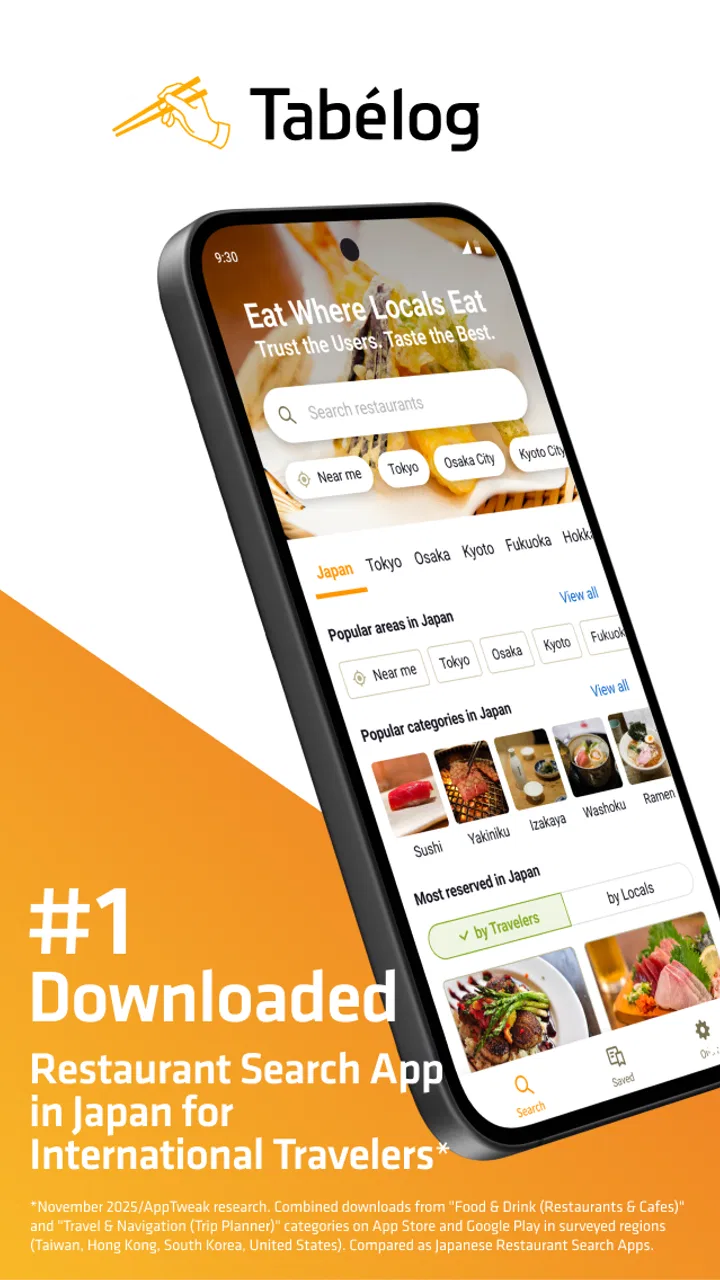
Tabelog - Food Guide in Japan
- 4.9
- Rating
- 500.00K
- Installs
- Free
- Price

 Analysis by App-foxy
I like food apps that help me make a decision rather than simply show me a long list of places. Tabelog - Food Guide in Japan takes that practical approach, with a focus on discovering restaurants in Japan and helping travelers from the United States understand where to eat. I found it most useful when I already knew the area or cuisine I wanted, but needed a more informed starting point than a general map search.
It is a free Food & Drink app from Kakaku.com, Inc., and its audience is quite clear: people looking for restaurants in Japan, especially visitors who may not know how local dining choices are organized. The app has an Everyone age rating, so it is suitable for a broad audience. Its current version is 2.11.0, and the overall reception is strong, with a 4.9 average from around 2.3 thousand ratings.
How Tabelog feels during everyday restaurant searches
My first impression was that the app is designed around the moment when a vague craving needs to become a real plan. “I want ramen near here” is easy to say, but choosing between a famous destination, a quiet neighborhood restaurant, a place suitable for a group, or somewhere convenient after a train ride requires more context. That is where this guide earns its place.
You May Also Like

 Blood Strike: 2.5 Anniversary
Blood Strike’s Loadouts Turn Every Drop Into a Tactical Gamble
A close look at Blood Strike’s custom loadouts: how fast access to signature weapons reshapes its battle royale rhythm, rewards preparation, and narrows the gap between fights.

 Pandora - Music & Podcasts
Pandora’s Music Is Easy to Start, but Harder to Recover
Pandora’s strength is its low-effort path from a seed to a station. Its weak spot is how much confidence it asks you to place in connection, setup, and quiet recovery.

 8 Ball Pool
 Is Built on Rivalries, Rematches, and Routine
A close look at the rivalries, rematches, shared routines, and unanswered safety questions that turn a quick pool match into a persistent mobile community.

 Samsung Music
’s Quiet Strength Is Playing What You Already Own
Its reach comes less from spectacle than from dependable access to a personal library. That simplicity is both the app’s strongest retention engine and its ceiling.

 AccuWeather: Weather Radar
AccuWeather Review: A Quick, Clear Forecast for Everyday Decisions
For everyday plans, the best forecast is the one you can understand quickly. AccuWeather makes rain timing, radar, and local conditions easy to act on, with a few trade-offs.

 Hill Climb Racing
Why Hill Climb Racing Still Turns Crashes Into One More Run
A tiny car, a bumpy hill and one more upgrade: Hill Climb Racing keeps resurfacing because its simple chaos makes every near-miss feel personal.
More From Our News Desk



The main advantage is its Japan-specific focus. A worldwide map app can be excellent for directions and opening hours, but it often treats restaurants as one category among many. Tabelog feels more centered on the dining decision itself. That difference matters when I am comparing several places in the same neighborhood rather than merely trying to locate the closest result.
The app’s store summary presents it as a way to find beloved restaurants in Japan and food guides for travelers from the U.S. I would describe it more simply: it is a restaurant discovery companion for people who want local food research before committing to a meal. It is not just a navigation tool, and I would not use it as a replacement for a full travel planner.
Its reputation is also notable. Tabelog has passed half a million installs, which suggests that it has reached a substantial audience without needing to be treated like a novelty travel app. That does not guarantee that every listing will suit every visitor, but it does make the service feel established enough to include in a Japan trip toolkit.
What makes the app useful before leaving the hotel
The best time to use it is often before hunger becomes urgent. I can imagine opening it in the morning, checking the part of town I expect to visit, and making a shortlist based on the kind of meal I want. This is more effective than waiting until lunchtime and then accepting the first nearby result with enough reviews.
A useful habit is to separate discovery from the final decision. I would use Tabelog to identify promising restaurants, then look carefully at the practical details shown for each candidate and consider the day’s route. A restaurant that looks ideal in isolation may be inconvenient if it requires a long detour, while a slightly less famous option may fit perfectly between two sightseeing stops.
This workflow is especially valuable for travelers who feel overwhelmed by Japanese restaurant names, neighborhood boundaries, and unfamiliar food categories. Instead of searching the whole country mentally, I can narrow the task to an area, a style of food, and a realistic time window. The strongest feature is not simply finding restaurants; it is reducing the number of uncertain choices.
Speed expectations when the search gets specific
In normal use, I expect the app to feel quickest when I approach a search with a clear purpose. Looking for a restaurant in a defined area should be a lighter task than repeatedly changing location, cuisine, and preferences while moving through a crowded station district. That is less a criticism of Tabelog than a reminder that restaurant discovery becomes demanding when the search keeps changing.
I would not judge its speed only by how rapidly the first screen appears. For this kind of app, the useful response is whether I can move from a broad search to a sensible shortlist without losing track of what I was comparing. A fast result that gives me no confidence is less valuable than a slightly more deliberate search that helps me choose.
Travel conditions can also affect the experience. Hotel Wi-Fi, crowded public networks, roaming connections, and underground stations are all common parts of a Japan trip. I would do the research while connected reliably rather than waiting until I am standing outside a station with low battery and an urgent appetite. That simple change makes the app feel more dependable because I am not asking it to solve every problem at the worst possible moment.
Handling busy planning sessions and heavy use
The most demanding use case is not a single restaurant search. It is a long planning session in which I compare several neighborhoods, revisit candidates, and adjust plans for different meals. A traveler may also use the app repeatedly during a day: breakfast research, a quick lunch decision, then dinner planning while walking between attractions.
For that pattern, I prefer a disciplined shortlist. I would keep a small group of realistic candidates rather than opening every interesting result. This reduces the mental load and avoids turning the app into an endless scrolling exercise. It also makes the final choice easier when the group is hungry and nobody wants another ten-minute debate.
Another practical tip is to search by the meal you can actually manage, not only by the meal you would ideally like. A destination restaurant may be worth a special journey, but a nearby option can be better after a full day of walking. Tabelog is most useful when I combine its restaurant discovery with honest planning about distance, timing, and energy.
I also think the app suits repeat visits to the same city. On a first trip, I may need broad guidance. On a later trip, I can use it to move beyond the places I already know and investigate a different neighborhood or style of food. That gives the app more long-term value than a one-time list of tourist recommendations.
Reliability and the limits of restaurant information
Restaurant information is never completely static. Hours, availability, seating rules, seasonal menus, and temporary closures can change, especially in a country where small independent restaurants are common. I would treat Tabelog as a strong research source, not as an absolute promise that a table will be waiting when I arrive.
That distinction is important for travelers. A listing can help me decide where to go, but I still need to use common sense about the day, the time, and the restaurant’s own current instructions. For a high-priority meal, I would verify the practical details before making a long journey. This is not a reason to avoid the app; it is the right way to use any restaurant guide.
The rating deserves a little interpretation too. A 4.9 average is impressive, but a high score does not tell me whether a restaurant matches my budget, preferred atmosphere, dietary needs, or tolerance for waiting. I would read the surrounding information and compare several options rather than treating the score as a universal answer.
The app has 17 written reviews shown in its store presence, while its much larger rating count reflects a broader response than those written comments alone. I would therefore avoid judging the entire experience from a handful of opinions. The more useful question is whether the app helps me make a better restaurant shortlist for my particular trip.
Device demands, battery, and travel practicality
Tabelog is not the kind of app I would expect to place unusual demands on a modern phone during ordinary browsing. Its role is restaurant research, so the heavier moments are likely to come from repeated searches and location-based use rather than from intensive graphics or continuous entertainment. Still, travel phones often begin the day with navigation, translation, photography, tickets, and messaging already competing for battery.
That is why I would use it strategically. Research restaurants in advance, save the important details in a personal note if necessary, and avoid keeping every travel app active while walking. A portable charger is more valuable than assuming any single app will be responsible for battery drain. The same advice applies to storage: I would keep the phone organized before a trip, particularly if I plan to take many photos and download maps.
Screen size also affects comfort. On a compact phone, comparing many restaurants may feel cramped, especially when I am trying to read details while standing. A larger display is better for planning, while a smaller device is perfectly adequate for checking one selected restaurant. This is a useful distinction: the app can support both research and quick reference, but those tasks do not feel equally comfortable on every device.
For travelers from the U.S., the app’s guide-oriented positioning is helpful because it acknowledges that visitors may need more than a Japanese-language restaurant directory. Even so, I would not assume that every cultural detail can be explained inside one app. Basic preparation about Japanese dining etiquette, cashless payment expectations, reservations, and food vocabulary can make the restaurant search much more successful.
Who should use it, and who may prefer another option?
I recommend Tabelog to travelers building a food-focused itinerary, visitors who want to look beyond the most obvious tourist results, and anyone who prefers researching several restaurants before choosing one. It is also a good fit for people who enjoy comparing neighborhoods and meal styles rather than relying on whichever business appears first on a map.
I would be more cautious about recommending it to someone who only needs turn-by-turn directions to a restaurant they have already chosen. In that situation, a standard maps app may be faster and simpler. Likewise, someone who wants a broad social feed, constant photo discovery, or restaurant delivery may find a different food service more natural.
The trade-off is specialization. A general map is often better for the complete journey: transit, walking routes, landmarks, and nearby services. Tabelog is better when the restaurant itself is the central question. I would happily use both together rather than forcing one app to perform every travel task.
It is also not the ideal choice for completely spontaneous dining when I have no time to compare options. The app becomes more valuable when I give it a clear job: identify candidates, understand the local food landscape, and help me choose a place that fits the day. If I open it only after everyone is already hungry, its research strengths have less room to help.
A realistic day using the guide
Imagine I am spending an afternoon in a busy part of Tokyo with two friends. We have eaten lightly, but we do not want to cross the city for dinner. I would open Tabelog while we still have time, search around the area we plan to visit, and create a shortlist with different levels of ambition: one destination-worthy restaurant, one practical nearby choice, and one backup.
That three-option method is one of my favorite ways to use a restaurant guide. It respects the original plan without pretending that travel is predictable. If the destination choice has an inconvenient location or the timing no longer works, the backup is already selected. We spend less time searching on the street and more time enjoying the evening.
For a solo traveler, the same workflow can be adjusted around comfort. I might prioritize location and a manageable meal over prestige. For a family, I would think about timing and ease. For a food enthusiast, I might accept a longer journey for a restaurant that feels distinctive. The app does not make those decisions for me, but it gives me a more focused place to make them.
Version, value, and my overall performance verdict
At version 2.11.0, Tabelog feels like a focused tool rather than a general-purpose travel platform. I appreciate that clarity. The free price makes it easy to add to a trip without turning restaurant research into another subscription decision, and the Everyone rating keeps it accessible for ordinary family travel.
My performance verdict is positive, with realistic expectations. I would use it for deliberate restaurant research, shortlist building, and discovering food options in Japan. I would not depend on it alone for navigation, last-minute certainty, or every piece of travel information. Its perceived speed is best when I search with a plan, its resource demands appear appropriate for normal browsing, and its reliability is strongest when I verify important details before making a special trip.
The developer, Kakaku.com, Inc., has built an app with a clear regional purpose, and that focus is its main strength. It does not need to replace every familiar travel app to be useful. In my experience, it works best as the food specialist alongside maps and basic travel tools.
My recommendation is simple: install Tabelog if choosing where to eat is an important part of your Japan trip. Use it before you are hungry, keep a practical backup, and judge restaurants by your own needs rather than by a score alone. If you follow that approach, this free guide can turn an uncertain meal decision into one of the more enjoyable parts of the day.
FAQs for Tabelog - Food Guide in Japan
01What is Tabelog and how does it work?
Tabelog is a comprehensive food guide app specifically for Japan, allowing users to discover restaurants and eateries across the country. It provides detailed reviews, ratings, and photos submitted by users, helping you to make informed dining decisions. The app also offers features like reservation options and personalized recommendations based on your preferences.
02Is Tabelog available in multiple languages?
Tabelog primarily operates in Japanese, which might be challenging for non-Japanese speakers. However, the app does offer basic functionality in English, including restaurant names and addresses. For a more seamless experience, users might consider using a translation app alongside Tabelog if they are not fluent in Japanese.
03How reliable are the reviews and ratings on Tabelog?
The reviews and ratings on Tabelog are user-generated, which means they reflect a wide variety of experiences from different diners. This crowdsourced approach generally provides a reliable overview of a restaurant's quality. However, like any review platform, opinions can vary, so it’s advisable to read multiple reviews to get a balanced perspective.
04Does Tabelog offer reservation services?
Yes, Tabelog offers reservation services for many restaurants listed on the platform. This feature is highly convenient for travelers and locals alike, allowing users to secure a table without language barriers. Reservation availability can vary by restaurant, so it's recommended to check the specific listing for options.
05Is Tabelog free to use, or does it require a subscription?
Tabelog is free to download and use, offering a wealth of information at no cost. However, there are premium features available through a subscription, such as advanced search options and exclusive dining guides. These features can enhance the user experience but are not necessary for basic usage.
Pros
- Comprehensive restaurant listings.
- User-friendly interface.
- Accurate location-based search.
- Detailed reviews and ratings.
- Variety of cuisine options.
Cons
- Limited English language support.
- Some outdated restaurant info.
- Occasional slow loading times.
- In-app ads can be intrusive.
- Requires account for full features.

Tabelog - Food Guide in Japan
Gallery